

Part 1: Activity 4.1: The Power of Everyday Connection
Table of Contents
Below are three scenarios that a person living with dementia might commonly experience. There are two versions of each scenario – one in a community that has strong connections, and one that does not. Explore this topic more here:

Read the two versions of at least one scenario and think about how connection changes the experience. Imagine you’re part of a similar moment – perhaps as a cashier, volunteer, or neighbour.
What could you do to make that experience smoother or more reassuring? Use the questions below to help you write a few ideas in your workbook or discuss them with a colleague.
- What made the first version different from the second?
- How might consistent, familiar interactions help someone feel calmer and more confident in daily life?
- What signals tell someone you’re paying attention?
- How can you communicate calm and care without words?
- What might ‘familiarity’ look or sound like in your role?
Lena’s Morning Errands
Lena takes her reusable shopping bag and steps out into the crisp morning air. She feels a flicker of hesitation – she is feeling good today, but she knows that things can get confused and forget where she is at any moment. At the corner, her neighbour, Mrs. Chen, waves. “Morning, Lena! Off to the bakery to meet your friends?” Lena smiles, a little more confident. “Yes, and then to the post office – it’s time to pay the bills”.

At the café, the barista greets her warmly: “Good morning Lena! Your usual? Chamomile tea, not too hot?” Lena nods and smiles. The barista offers to bring it to Lena at her table when it’s ready – a quiet courtesy that helps. Lena joins a table with her friends, Kathy and Simone, and they fall deep into conversation. Suddenly, Lena goes pale and quietly exclaims “There’s something really important that I have to do today, but I have forgotten what it is. What am I going to do?”. Kathy gently inquires, “was it the post office? I think you mentioned that earlier. Do you mind if I join you? I have to mail something myself.” Relieved, Lena settles back into the conversation.

At the post office, she doesn’t recognize the clerk, but something inside her makes her feel reassured as she approaches the desk. She fumbles with her purse, her anxiety starting to build, but the clerk smiles and says, “No rush, take your time.” On her way home, she says goodbye to Kathy and stops to rest at the bench near the flower shop. The owner waves through the window, and Lena waves back. When she gets home, she is ready to sit down in front of her favourite television show.
It’s bill day and Lena has been worrying about it for several days – it’s getting harder and harder for her to do even the easy things, but maybe a trip to the café on the way will help. She hesitates at her door. She can’t quite remember the route to the café but sets off anyway.

At the crosswalk, she pauses too long, and a driver honks. Her chest tightens. She arrives later than usual so the café is busy; unfamiliar staff are working. “What can I get you?” one says quickly. Lena’s mind goes blank. “Tea?” she manages. It arrives too hot, too fast and she can’t find a table.

Feeling increasingly anxious, she places her unfinished tea on the counter and leaves the café to go home. She has forgotten about the bills she needs to pay. By the time she returns home, she’s exhausted and feels alone. The bills remain unpaid and she can’t find the remote control for the television.
Raymond’s Trip to the Community Centre
Raymond, a retired bus driver, looks forward to Fridays. That’s when he visits the community centre for his dance class. He’s slower now, and sometimes forgets which locker is his, but he enjoys the familiar rhythm of the music and the movement. He still knows the drivers on his normal route, so they always make sure he gets there safely and on time. And even if he’s late, they always hold his spot for him.

At the desk, Nora the receptionist greets him: “Hey Ray, Sally has a great class planned for today – I think you’re going to love it.” She’s written his locker number on a sticky note, just in case.
After his class, he stops at the café for a pastry and a chat with a few others from the group. The server offers him a choice between two of his favourites – a small gesture he really appreciates. He enjoys being able to choose, but too many options in the display case can feel overwhelming. When he arrives home, his neighbour Liam has cleared the snow right up to his door – a big relief. “Looks like the Oilers might win this weekend!” Liam calls. Raymond laughs. “They’d better!”

The bus route to the community centre has changed again, but Raymond doesn’t notice until he’s halfway across town. The new driver doesn’t recognize Raymond, so didn’t let him know where to get off. When Raymond finally gets up the courage to ask, the driver is very friendly, but there’s not much he can do – Ray worries he’ll be late for his class.

By the time he reaches the gym, he’s flustered and has lost track of time. He goes to the desk and explains why he is late. The lady at the desk apologizes and explains politely that they thought he wasn’t coming, so gave his spot to someone on the waitlist.

Dejected, Ray goes to the café while he waits for the next bus home. The menu board has so many options and it’s hard to decide. He squints, uncertain. The server waits, pen poised. “Uh… coffee?” he says. She adds milk automatically, though he hasn’t taken it that way in years. Back on the bus, he stares out the window, disappointed. He wonders if he’ll even bother trying next week.
Aisha’s Library Visit
Aisha loves reading but sometimes forgets what she’s come to find. The staff at her local library know her well and when she arrives, Maria at the front desk smiles: “Hi Aisha! The new gardening books are in. Do you want me to show you?”
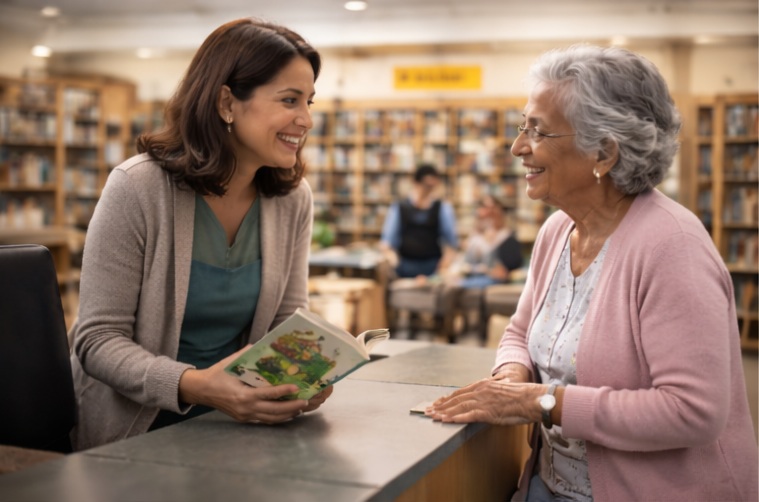
Aisha nods gratefully. The bright yellow signs and uncluttered aisles make navigation easy and the familiar smell of the books makes her feel content. She spends time in the reading nook near the window and then helps one of the volunteers with a problem she’s having with her tomato crop this year. It’s so nice to feel useful.

On her way home, she stops at the grocery store next door. The person on the checkout recognizes her and packs her items slowly and gently, making sure the bag will be easy to carry. On her walk home, the neighbour’s dog barks a friendly hello, and Aisha laughs.
Aisha has always loved reading, and the local library is like a second home. Recently, there have been a lot of new staff and volunteers, and while they’re friendly enough, she doesn’t feel as comfortable as she once did. Today, the library feels noisier than usual – or maybe she’s a bit on edge after the incident at the bus stop earlier. The new volunteer at the desk asks, “Can I help you find something?” Aisha hesitates, searching for words. “Book… flowers?” The volunteer looks puzzled, then points to a general section.

The shelves feel taller than she remembers. She wanders, disoriented, until a sudden announcement startles her. She leaves empty-handed.
At the grocery store, the clerk moves quickly, scanning items before she’s ready. Aisha fumbles with her wallet. “Take your time,” the clerk says automatically, but her eyes are already on the next customer. When Aisha gets home, she sits quietly in her chair for the rest of the day, sad that she didn’t get the new book she had been excited to start reading.

Strong communities are built through countless small interactions – greetings, smiles, shared stories, and moments of kindness. That’s why something as simple as remembering a regular customer’s favourite drink or saying “It’s nice to see you again” isn’t small at all –it’s planting a seed of emotional safety.
For people living with dementia, these moments are even more powerful. Consistent, positive interactions create a sense of predictability and trust. They help people feel they belong, even as other aspects of life become confusing or uncertain. When someone feels safe and understood, their brain can relax. Stress and fear decrease, and confidence increases.
It’s also important to remember that everyone – including people living with dementia – has good days and bad days. Being Dementia Supportive means showing up on both. On the good days, your effort helps keep the world open and inviting; it reinforces confidence and connection. On the harder days, the trust you’ve already built helps restore calm and dignity when things feel unsettled.